
Checking Criminal History in Bridgeport
There is no single Fairfield County custodian and no Bridgeport portal that combines every criminal record. Start with the free Connecticut Judicial Branch Criminal/Motor Vehicle Case Look-up for filed cases, then match any result to the police, repository, or custody source that answers the remaining question. Have the full name, date of birth, spelling variants, approximate event date, and—when possible—the police incident or court docket number.
A common name is not enough to establish identity. Compare the court location, docket year, charge, arrest date, and birth information that the official result makes available. Protected juvenile and youthful-offender matters will not appear in the ordinary public search.
- Search pending cases, convictions, daily dockets, or public arrest warrants through the Judicial Branch.
- Use a docket number when known; otherwise search the defendant name and compare identifying case details.
- Call Bridgeport Police Records at 203-581-5270 for a report number and readiness, or Booking at 203-581-5141 for a current booking question.
- Check the Connecticut DOC inmate search if custody may have moved from city booking into the state system.
- For your own statewide history, order the appropriate SPBI/CCHRS product and obtain a certified court disposition if an outcome is missing.
The four Judicial Branch views answer different questions. Pending-case search follows an unresolved prosecution, conviction search focuses on qualifying displayed outcomes, the daily docket shows a scheduled calendar, and the arrest-warrant route covers only public warrant information. A person absent from one view may appear in another. When a result shows a CR docket, record the complete number: its location prefix identifies the originating court, its two-digit segment marks the case year, and its suffix can identify an original, transferred, or severed file.
If the need is a police narrative rather than court history, switch channels instead of treating a docket printout as the report. For proof of outcome, request the court’s certified disposition. For review of your own statewide arrest cycles, use SPBI rather than assuming Bridgeport’s local files cover events elsewhere in Connecticut.
Reports and Booking at Congress Street
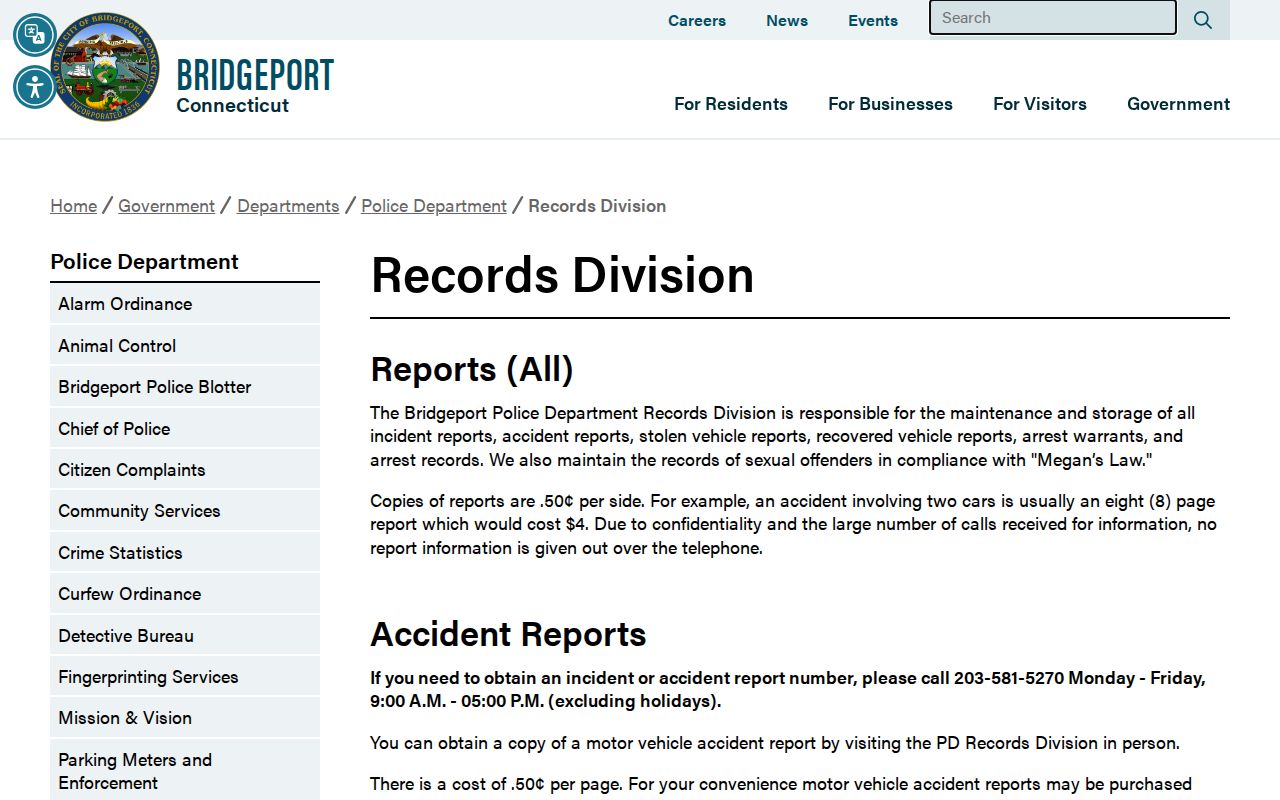
Bridgeport Police Records maintains incident, accident, stolen or recovered vehicle, arrest-warrant, and arrest files. Call 203-581-5270 Monday through Friday, 9 a.m. to 5 p.m., to obtain the report number and ask whether a copy is ready; report details are not released by phone. Copies cost $0.50 per side, and the department advises allowing seven to ten working days for reliable availability. Accident reports may be purchased online after five business days for an added vendor fee.
The city’s GovQA portal is the electronic Connecticut Freedom of Information Act request route. A narrow request with the incident number, date, location, agency, and clearly described record is easier to process. Police generally withholds an arrest-connected incident narrative until adjudication; basic arrest information, a defense discovery request, and the full police narrative are distinct access questions.
Victims seeking an arrest-connected report are directed to the court victim advocate, while a represented arrested person should work through counsel or the Public Defender’s Office during the pending case. Juvenile and sexual-assault reports require command approval. Those restrictions do not turn every basic arrest fact into a confidential record, but they make a request for a specific releasable item more useful than a request for “everything.”
Fairfield County Is Not the Custodian
Local system quirk: Connecticut abolished county government. “Fairfield County criminal records office” is therefore not an agency that can fulfill a request.
Bridgeport’s records are divided by function. Police reports and local booking begin at 300 Congress Street. Adult criminal cases go to state Superior Court at either Part A, 1061 Main Street, or G.A. 2, 172 Golden Hill Street. Statewide fingerprint-supported histories belong to SPBI, while custody after transfer belongs to Connecticut DOC. Choosing the custodian first prevents a request from circulating among offices that never held the desired record.
Bridgeport Police Records
300 Congress Street · 203-581-5270
Incident, arrest, warrant, accident, and local report files
Superior Court, Part A
1061 Main Street · 203-579-6527
Primarily class A and B felonies and serious transferred matters
Superior Court, G.A. 2
172 Golden Hill Street · 203-362-0150
Class C–E felonies, misdemeanors, infractions, and motor-vehicle matters
SPBI
1111 Country Club Road, Middletown · 860-685-8480
Connecticut criminal-history repository products
These offices are close geographically but institutionally separate. Part A and G.A. 2 are both Connecticut Superior Court locations, not county or municipal courts. Juvenile matters at 60 Housatonic Avenue are confidential and excluded from the adult public lookup. Probation is state-administered, while parole decisions and supervision connect to the Board of Pardons and Paroles and DOC rather than a county department.
Connecticut Official Background Checks
The Connecticut Department of Emergency Services and Public Protection, State Police Bureau of Identification (SPBI), is the central repository. Its records page distinguishes a $36 name-and-date-of-birth search that reports whether a record exists from the $75 name-based conviction history and $75 fingerprint-supported conviction route. The existence search is not a rap sheet and supplies no charge or disposition detail.
For personal review, CCHRS pre-enrollment starts the request workflow, after which fingerprints are captured through a participating law-enforcement agency. Bridgeport Police lists criminal background checks through Records and fingerprinting through the Detective Bureau, but a local Bridgeport check must not be represented as the statewide SPBI history.
Using CCHRS for Your Own Record
The Connecticut Criminal History Request System is the practical starting point for ordering your own repository record. Select the product before paying: an existence response, a conviction search, and a fingerprint-supported personal record do not provide the same evidence. The request form calls for requester contact information, the subject’s name and aliases, date of birth, and additional identifiers; the fingerprint route also requires a card captured by law enforcement.
| SPBI option | Fee | What it answers |
|---|---|---|
| Name/DOB existence search | $36 | Whether Connecticut repository data exists; no detailed history |
| Name/DOB conviction history | $75 | Reportable conviction information matched by name and birth date |
| Fingerprint-supported history | $75 | Stronger identity match for personal review and correction |
Criminal Record Types
A “criminal record” can mean a police narrative, arrest event, booking intake, court docket, repository history, custody profile, warrant, supervision entry, or registry profile. Each is created for a different operational purpose, so one may exist when another does not.
- Arrest and booking records — Bridgeport Police documents the arrest allegation and intake at Congress Street.
- Criminal court case files — Superior Court records filed charges, bond, hearings, pleas, disposition, and sentence.
- Repository histories — SPBI compiles reported fingerprint-supported arrest cycles and outcomes across Connecticut.
- Warrants — the Judicial Branch has a public arrest-warrant route, while sealed warrants remain unavailable.
- Custody, supervision, and registry records — DOC, probation/parole authorities, and DESPP maintain separate status systems.
The Four-Stop Bridgeport Record Trail
| Stop | Best for | Limitation |
|---|---|---|
| Bridgeport Police | Incident, arrest, warrant, accident, and booking records | Arrest-connected narratives are held until adjudication |
| Superior Court | Filed charges, docket activity, and final disposition | Online display is not the certified official file |
| SPBI | Connecticut repository history and identity-based review | Product scope varies; disposition reporting can lag |
| Connecticut DOC | Current state custody and sentence/release fields | Includes accused people and does not prove guilt |
Use the records together, not interchangeably. An initial police charge can be reduced, replaced, or declined by the prosecutor. A court disposition can post after the repository arrest cycle. DOC can hold a pretrial person whose case has no conviction. The originating office remains the authority for correcting its part of the trail.
Inside a Bridgeport Criminal Record
The fields depend on the source. A complete comparison may connect identity information, an arrest cycle, the court docket, disposition, sentence, and current custody or supervision. Absence from one public interface does not erase another agency’s underlying record.
| Name & Identifiers | Names and aliases, birth information, SPBI number, DOC number, or transaction identifiers where applicable. |
|---|---|
| Arrest / Booking Data | Agency, event date and place, report/booking number, initial allegations, bond, and transfer status. |
| Charges & Statutes | Counts, Connecticut statute citations, classifications, and later prosecutor-filed charges. |
| Disposition | Dismissal, nolle, acquittal, plea, conviction, or other final court outcome. |
| Sentence | Incarceration, suspended time, probation, fines, and court-ordered conditions. |
| Custody / Supervision Status | DOC location and release fields or the applicable probation/parole status, subject to access limits. |
Public Access Laws in Connecticut
The Connecticut Freedom of Information Act, CGS §§1-200–1-242, favors inspection and copying of public-agency records but preserves exemptions for active investigative technique, confidential sources, witness safety, juvenile information, victim privacy, and records made confidential elsewhere. Ask for segregable, nonexempt portions when part of a file is withheld.
Key Statutes:
CGS §1-210 — establishes public inspection and copying rights and enumerates exemptions.
CGS §1-215 — addresses disclosure of basic arrest information.
CGS §§29-11–29-17 — govern SPBI criminal-history dissemination and fees.
CGS §54-142a — controls erasure of qualifying criminal records.
The Ten-Year Display Limit
Connecticut’s conviction search generally displays cases sentenced within the preceding ten years. That website rule is not a declaration that every older underlying record was erased. A case may also disappear because of a correction, pardon, or statutory erasure. The Judicial Branch expressly describes its website as a public convenience rather than the official record.
When an expected Bridgeport result is absent, identify the correct courthouse from the docket or charge level. The Part A clerk at 1061 Main Street and G.A. 2 clerk at 172 Golden Hill Street can explain inspection and certification procedure. For a repository discrepancy, compare your SPBI history with the certified disposition and submit the correction through SPBI.
Sealed, Erased, and Restricted Records
Connecticut uses “erasure” for qualifying dismissed, not-guilty, and nolled matters under CGS §54-142a, with statutory conditions and waiting rules. Juvenile and youthful-offender proceedings follow separate confidentiality protections. A missing public result may reflect one of these restrictions, but it can also reflect the court website’s display limits or a data mismatch.
Clean Slate can automate erasure for eligible convictions after statutory periods, yet excluded offenses and identity-matching exceptions remain important. An absolute pardon through the Board of Pardons and Paroles can also produce erasure consequences. For personal review, compare the court disposition and SPBI history before choosing a remedy.
Clean Slate, Erasure, and Pardons
These are three different paths. Traditional erasure follows the conditions in §54-142a for specified outcomes. Clean Slate applies statutory automation to eligible convictions, although DESPP warns that appearing on an eligible-offense list does not guarantee a particular case will match. An absolute pardon requires an application to the Connecticut Board of Pardons and Paroles.
The Board currently charges no application fee, but its process requires a recent SPBI report. CCHRS pre-enrollment, fingerprints, the $75 state history fee unless waived, and certified dispositions for missing outcomes can therefore be part of the preparation. After any relief is processed, recheck both the court interface and your repository history rather than assuming every system updated simultaneously.
Bridgeport Criminal Records by City
This project focuses on Bridgeport, Connecticut’s largest municipality, rather than a three-city county directory. Bridgeport Police creates city reports and booking records, but Connecticut Superior Court—not a municipal criminal court—handles prosecutions. The city guide connects those local police channels to the state court, SPBI, and DOC systems.
Bridgeport Criminal Records
151,599 estimated residents in 2024 · Police records at Congress Street; adult cases in state Superior Court
Bridgeport’s State-Run Custody Model
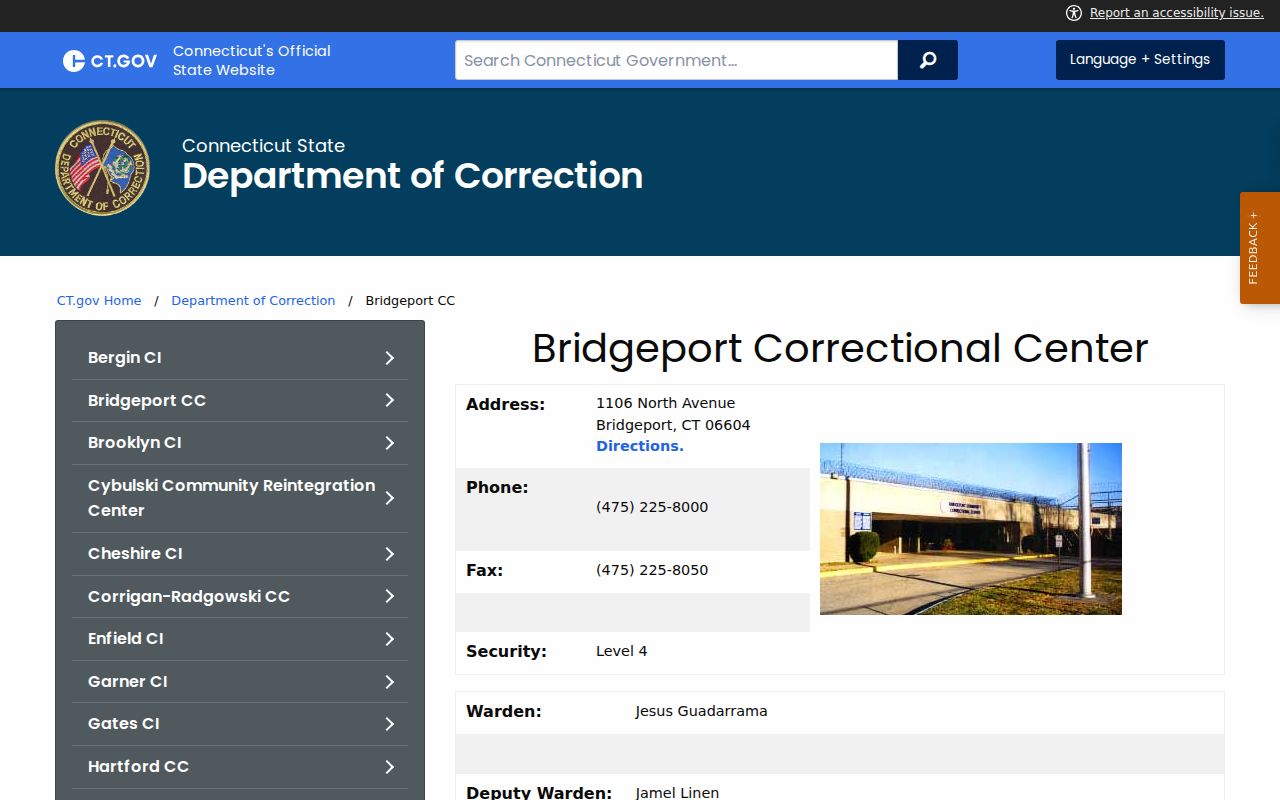
Bridgeport Correctional Center at 1106 North Avenue is a Level 4 state facility that holds both pretrial accused people and sentenced people. It opened in 1958, added the New Center in 1974, and includes a Level 2 workforce unit. That mixed population is why a positive Connecticut DOC inmate search result cannot establish a conviction.
DOC data updates daily and may show inmate number, identity, location, controlling offense and sentence or release fields where applicable. A negative result can mean release, no state transfer, spelling mismatch, timing, or an excluded youthful-offender category. For urgent local booking questions, the appropriate first call remains Bridgeport Booking rather than the state facility.